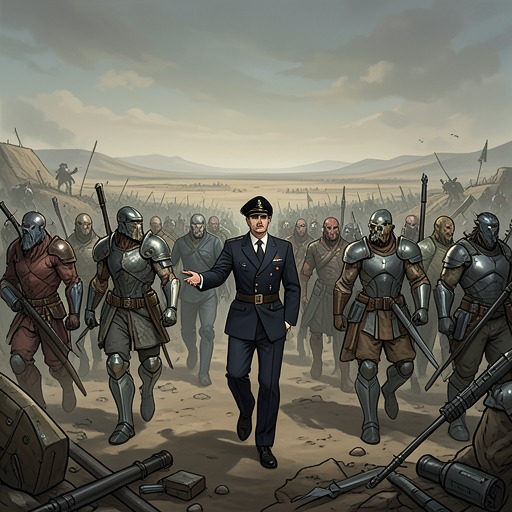
Battle of Rikel
Systema Delenda EstThe Battle of Rikel is the longest single battle in the fifty-plus-year System campaign and the clearest demonstration that Cato’s exponential expansion does not automatically produce strategic victory. After the System annexes Rikel and publicly opens its portal, Cato moves almost immediately, forcing the System’s defenders to confront an enemy whose industrial base extends across hundreds of worlds. The ensuing six months of constant combat become a contest between Cato’s distributed manufacturing and the System’s ability to conceal, reinforce, resurrect, and protect its holdings. Rikel survives not because Cato lacks force, but because the System turns access, timing, and attrition into weapons of its own.
Causes and Strategic Background
The battle begins with the annexation of Rikel. The System’s Elders suppress the initial broadcast of the annexation, apparently hoping to measure how long it takes Cato to discover the event and move his forces. Once the portal opens and the news can no longer be hidden, the defenders watch the heavens for signs of his response. Within roughly an hour, several stars begin to move: immense pieces of Cato’s artificial infrastructure are already in motion, still outside the System but close enough to threaten Rikel and its defenders. Muar and Misse recognize that Cato’s speed may mean he had prepared forces in advance, but the timing also suggests that he deliberately waited for the annexation to become public before acting.
Cato-Rikel has had eleven years to prepare. He establishes manufactories throughout the heliosphere, concentrating on a metal-rich asteroid belt containing four dwarf planets almost the size of Ceres. The lighter elements prove more difficult to obtain: helium and oxygen must be drawn from hot gas dwarfs deeper in the system, while methane and ammonia come from large icy bodies in the outer system and are cracked into their components. Mass drivers send resources toward rendezvous points at the edge of Rikel’s sphere of influence, creating a logistics chain that takes months to operate from end to end. Once that infrastructure is in place, however, it can produce a very large force.
The wider strategic basis of the battle is Cato’s exponential growth. The Lineages have helped spread him across hundreds of worlds, and each world has been pushed into full industrialization through factories, mines, refineries, atmospheric extraction, volatile processing, and vast solar arrays. Cato cannot move armies through portals in a meaningful way, but each world can build and sustain its own forces. A relatively small fraction of every production base is devoted to weapons and warframes, while a larger portion is designed for rapid conversion between industrial and military purposes. After the warning from Koh-rel, that retooling begins. The result is a war machine whose local contingencies accumulate into staggering absolute capacity.
Course of the Battle
The battle lasts six months without interruption, making Rikel the longest single engagement in the campaign. A virtual war room records war materiel spreading above the atmosphere from beyond lunar orbit down toward the region where System-imposed physics prevents advanced technology from functioning properly. Raine manages the orbital defenses while Cato attempts to move deliveries past the Azoths. The enormous destructive field generated by the System’s high-rank defenders makes every delivery hazardous; even with many craft in motion, success depends on luck, misdirection, and brief openings in the enemy’s attention.
Cato’s force is immense. Millions of Big Bad Bug Bombs, billions of tons of war materiel, hundreds of particle beams, antimatter-shot fighter craft, enough warframes to saturate the planetary surface, and observation satellites supported by sufficient computronium to monitor every individual on Rikel all participate in the campaign. The scale is not merely rhetorical: the battle presents industrial capacity as a form of battlefield presence, with surveillance, manufacture, orbital insertion, and biological deployment functioning as one integrated system.
One operation succeeds beyond expectation. While the fighting over Rikel intensifies, a Lineage in a Jager Frame crosses into another world and manages to place one of the oversized spears into orbit. The diversion gives the infiltrating force a temporary path through the System’s defenses, and the foothold appears sufficient to begin crashing the System there. That achievement shows the broader logic of Cato’s strategy: he does not need to conquer every world through a single centralized army. A foothold in orbit can eventually become infrastructure, and infrastructure can become a new local campaign.
Rikel itself is harder. Raine celebrates individual hits, but striking an attacking Azoth is extraordinarily difficult. Ballistic denial cannot reliably stop a man-sized target; the target must be hit with antimatter or a particle beam, and at the relevant distances even advanced targeting systems struggle against erratic movement. Some Azoths fail to understand the value of random-walk dodging and are destroyed, while others evade the attacks. Yet each apparent kill remains provisional. The System’s extra lives apply to Cato’s weapons even though his methods fall outside ordinary System specifications. Some Azoths do not return, but enough resurrect that every successful strike is only a temporary victory.
Defenders, Restrictions, and Stalemate
Muar is among the most important defenders of Rikel and serves as the head of the Crusade against Cato. His apparent near-invulnerability frustrates the attackers: eight particle-beam hits over the preceding months, including three direct strikes, fail to remove him permanently. Cato assumes that Muar has resurrections in reserve and may receive special consideration because of his leadership role. Raine therefore wants the more immediate satisfaction of killing Muar, while Leese recognizes that the real objective is to exhaust the defenders’ available lives rather than mistake any single death for a final result.
The possibility that a System-god could grant additional resurrections makes the problem still more uncertain. Initik and Mii-Es, together with information gathered from independent gods whom Cato has freed, have not been able to clarify the System’s architecture. The difficulty is hierarchical: the powers available to Core Deities differ radically from those available to ordinary World Deities, just as an administrator’s console differs from an ordinary client’s interface. Rikel therefore becomes a test not only of weapons but of the limits of System authority.
The System also locks the dungeons on Rikel and on several other worlds. Cato needs access to those dungeons to begin the process of severing Rikel, but the lockdown prevents him from reproducing the strategy used against Gogri. The measure consumes enormous amounts of essence on an individual planet, yet the wider System can offset the expense. That asymmetry leaves Cato with no simple answer: he can escalate by capturing worlds farther upstream, but doing so risks opening another war, and he is not yet certain that severing Rikel is worth the cost. The battle consequently settles into a holding pattern despite the overwhelming resources surrounding the planet.
Consequences and Wider Significance
Rikel proves that Cato’s industrial revolution has changed the scale of the war without abolishing its old constraints. Exponential growth is described as something that can be incredibly slow and then suddenly overwhelming, but the Battle of Rikel shows the converse as well: even a force built through decades of distributed growth can be checked by a bottleneck in access. Cato can manufacture more weapons, move more materiel, and establish more orbital footholds, yet he cannot convert those advantages into the immediate severance of a defended world while the dungeons remain locked and the Azoths continue returning.
The battle also clarifies the contrast between Cato and the System as competing technical societies. The System relies on dungeon control, hierarchical permissions, divine assistance, and resurrection mechanics; Cato relies on industrial redundancy, biological weapons, orbital logistics, surveillance, and local self-sufficiency. His warframes themselves embody that conflict. The System’s exotic physics disables most complex technology, forcing Cato to use organic machinery and a vulnerable blank System interface embedded in a warframe’s skull, while his broader infrastructure remains distributed beyond the System’s normal technological restrictions. Rikel is therefore fought simultaneously inside and outside the System’s permitted reality.
The battle’s unresolved ending is its defining consequence. Cato does not abandon the campaign, but neither does he drive the System from Rikel. The defenders’ use of locked dungeons and resurrecting Azoths converts battlefield destruction into attritional delay, while Cato’s ability to establish footholds elsewhere prevents the stalemate from becoming a straightforward defeat. Rikel remains a warning to both sides: the System can still contain a concentrated assault, but Cato’s forces are too widespread for one successful defense to end the war. The result is not a decisive conquest but a strategic revelation—that the campaign has become a struggle between networks, and that victory will depend on breaking the opponent’s supporting structure rather than merely overpowering the forces visible above one world.